
TITAN Vision Platform: Machine Vision Framework Optimized for Industrial Environments

Industrial-Grade AI Vision Platform for High-Performance Inspection Systems
TITAN Vision Platform is a machine vision framework optimized for industrial environments.
Built on a real-time inspection pipeline and a high-speed image processing engine, TITAN enables the development of reliable industrial inspection systems.
It supports multi-camera inspection environments and combines AI-based inspection with rule-based vision algorithms, providing high accuracy and flexibility across a wide range of industrial processes.
System Architecture
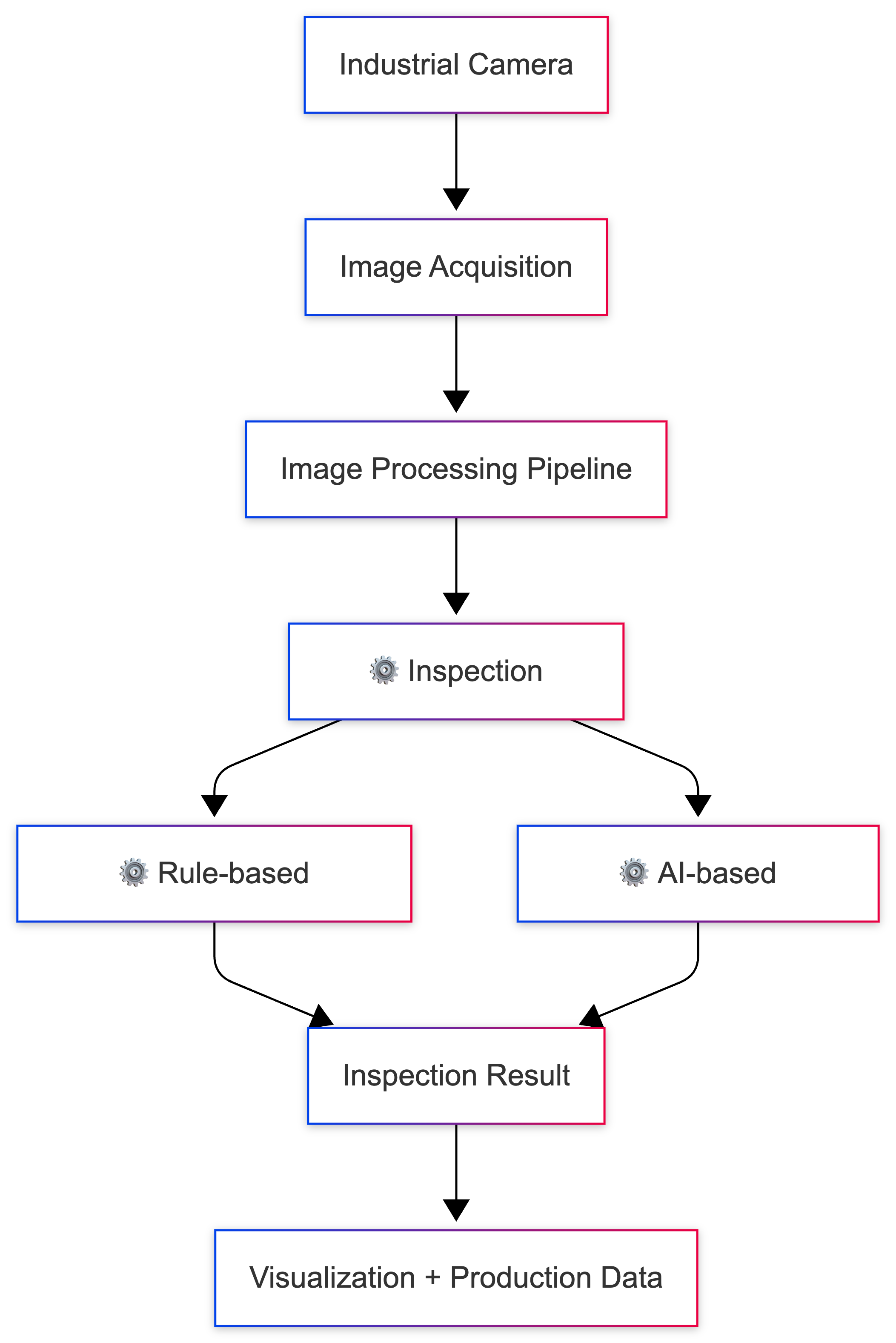
Core Modules
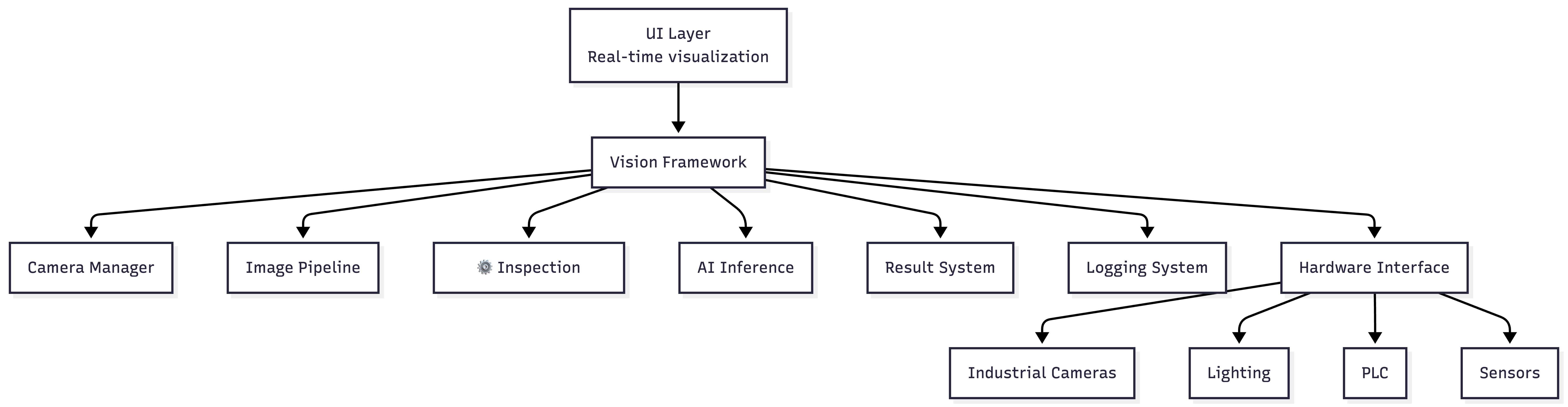
Camera Manager
Responsible for industrial camera control and image acquisition.
Key features:
- GigE Vision camera support
- Hardware trigger synchronization
- Simultaneous multi-camera acquisition
- High-speed frame capture
- Buffer management
Image Processing Pipeline
Handles real-time frame processing and the overall inspection flow.
Pipeline stages:
- Image acquisition
- Image preprocessing
- ROI extraction
- Inspection processing
- Result generation
The pipeline is optimized for low-latency, real-time inspection.
GAUR Inspection Engine
The core inspection engine of the BISON Vision Framework.
GAUR is named after the Gaur (Bos gaurus), one of the world’s most powerful wild cattle species.
Design principles:
- Powerful processing performance
- High-speed inspection
- High reliability in industrial environments
GAUR AI Inference Engine
Provides deep learning-based inspection capabilities.
Supported functions:
- Object Detection
- Classification
- Segmentation
- Anomaly Detection
- OCR
Optimized inference backends can be used for high-performance AI processing.
Examples:
- TensorRT
- Custom C++ Inference Runtime
Visualization UI
A real-time monitoring interface for inspection systems.
Features:
- Real-time camera view
- Inspection result overlays
- ROI configuration
- Production status monitoring
- System status display
Production Logging System
Records inspection results and system events.
Logged data includes:
- Inspection results
- OK / NG statistics
- Cycle time
- Camera events
- System logs
This enables production traceability and quality analysis.
Software Architecture
Performance Architecture
TITAN uses the following technologies to support high-speed production lines:
- Multithreaded processing
- Asynchronous image pipelines
- Ring buffer memory management
- Parallel inspection execution
- Non-blocking UI updates
Key Machine Vision Applications
- Surface defect inspection
- Assembly verification
- Dimensional measurement
- Product classification
- Barcode recognition
- Presence / absence inspection
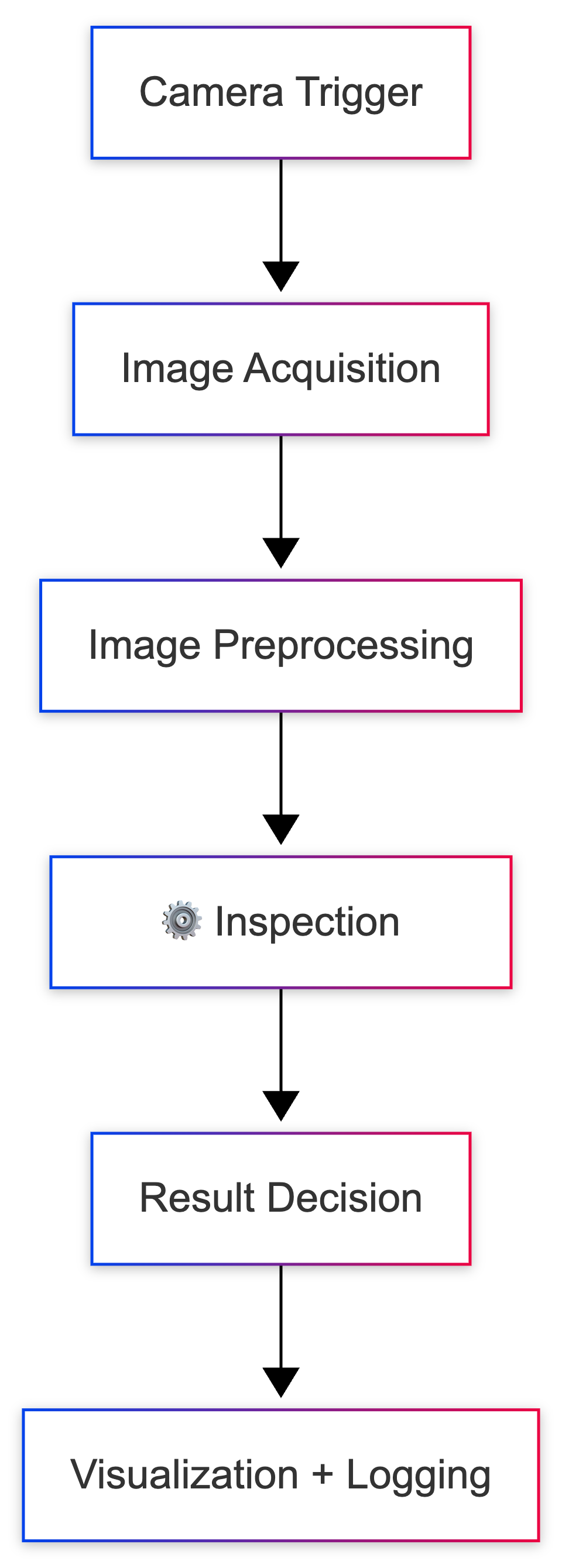
Example Inspection Workflow
Supported Hardware
Typical system configuration:
- Industrial PC
- Intel CPU
- NVIDIA GPU (Optional)
- GigE Industrial Camera
- Industrial Lighting
- PLC Interface
Design Philosophy
The BISON Vision Framework was developed around the following goals:
- Reliability in industrial environments
- Real-time processing performance
- Modular architecture
- Scalability for AI-based inspection
- Multi-camera scalability
Bring BISON's AI technology to your production floor.
Our experts will help you find the best way to implement it.
Get an EstimateRelated Insights
HOLSTEIN: Data Management Platform Built for Manufacturing Environments
HOLSTEIN Manufacturing Data Platform Overview HOLSTEIN is a manufacturing data platform designed to systematically manage and accumulate inspection and production data generated on the factory floor. It organizes inspection data, defect information, process data, equipment information, and engineering know-how generated throughout projects within a consistent structure, improving both data reusability and long-term value. --- Key Features Manufacturing Data Management HOLSTEIN provides centralized management of various types of manufacturing data. Product information management Process information management Inspection data management Defect data management Equipment information management Project history management Inspection Know-How Management Engineering experience and know-how generated during projects can be accumulated and managed as reusable data assets. Inspection condition management Optimization history management Defect analysis records Troubleshooting case management Operational know-how management Data Standardization HOLSTEIN standardizes information that would otherwise remain fragmented across individual projects, creating a consistent data management environment. This can provide benefits such as: Shorter deployment time Improved engineering efficiency More consistent inspection quality Reuse of existing project assets Continuous Data Asset Development Inspection systems generate more data as they continue to operate. HOLSTEIN systematically accumulates this data and transforms it into a digital asset that can contribute to greater manufacturing competitiveness over time. --- Benefits Faster Deployment Data and knowledge from previous projects can be reused to reduce the time required to deploy new projects. Improved Quality Accumulated data can be used to establish more stable and consistent inspection environments. Preservation of Engineering Know-How Experience and technical knowledge can be managed as structured data, helping preserve them as long-term organizational assets. Continuous Improvement As the number of projects grows, the accumulated data assets also expand, enabling greater productivity and operational efficiency. --- Vision Manufacturing competitiveness starts with data. HOLSTEIN continuously accumulates manufacturing data and field experience to create faster, more accurate, and more efficient manufacturing environments.
RANI: Edge AI Inspection Platform for On-Site Processing Without a Server
From Camera Acquisition to AI Inference, Rule Inspection, PLC Communication, and Data Logging — All in One System When introducing AI inspection into a manufacturing environment, simply running an AI model is not enough. The entire inspection workflow must operate reliably within a single system: acquiring images from cameras, analyzing defects with AI, evaluating inspection conditions using rule-based logic, transmitting results to the PLC, and recording inspection data. RANI (Real-time AI Networked Inspection) is BISON’s Edge Vision Framework designed specifically for these industrial inspection environments. RANI is optimized for NVIDIA Jetson-based edge devices, enabling image acquisition, AI inference, inspection judgment, and PLC output directly on-site without requiring a separate AI inference server. Why an Edge AI Inspection Platform Is Needed In manufacturing environments, AI inspection depends heavily on inspection speed, equipment integration, and network reliability. A server-based architecture that sends images to an external server for AI inference can increase system complexity and may introduce latency or network dependency depending on the production environment. RANI is designed for NVIDIA Jetson-based edge devices, allowing image acquisition, AI inference, inspection judgment, and PLC output to be handled directly on-site without a separate inference server. By leveraging Jetson-based GPU acceleration, RANI can build real-time inspection pipelines even on compact edge devices, enabling fast inspection decisions close to the production line. Core Inspection System: Integrating AI and Rule-Based Inspection in a Single Workflow RANI provides an AI-powered inspection pipeline designed to operate on compact edge devices. The system connects camera integration, AI inference, rule-based inspection, PLC control, and data logging into a unified workflow. Industrial camera image acquisition AI-based inspection Rule-based inspection AI + Rule hybrid inspection PLC-based inspection cycle control Real-time inspection result processing This enables the implementation of a complete industrial inspection system for real production environments, rather than simply running an AI model in isolation. Camera & Device Integration: From Triggered Capture to PLC Control RANI provides camera and automation equipment integration features designed for industrial production lines. Basler GigE camera integration Extensible architecture for various industrial cameras Soft Trigger support Continuous Acquisition support PLC-based inspection cycle control OK / NG result output When an inspection is initiated through a PLC or I/O trigger, the full sequence — image capture, AI inference, rule-based inspection, result judgment, and PLC output — is processed in real time. AI + Rule Hybrid Inspection: Combining AI Flexibility with Rule-Based Consistency In industrial inspection, it is often more effective to combine AI with rule-based logic rather than relying on AI alone for every decision. AI models are particularly effective at detecting complex patterns and irregular defects, while rule-based inspection is well suited for clearly defined criteria such as position, dimensions, regions, and threshold conditions. RANI allows AI inspection functions such as Object Detection, Segmentation, Classification, and QR Code Detection to be combined with rule-based inspection logic within a single workflow. This approach combines the flexibility of AI with the consistency of rule-based inspection, helping improve both inspection accuracy and decision reliability. Inspection Monitoring: View Inspection Status and Result Images in Real Time RANI provides real-time monitoring capabilities even in edge environments, allowing inspection results to be reviewed and analyzed directly on-site. Real-time inspection result display Inspection status monitoring Inspection image review ROI-based result visualization ROI overlay display Operators and quality personnel can immediately review inspection status and result images, making AI and rule-based inspection outcomes easier to understand visually. Logging System: Recording Inspection Data for Quality Analysis and Traceability RANI includes a lightweight asynchronous logging system designed to operate reliably on edge devices. Supported Log Formats CSV Image PNG / JPG / BMP Recorded Data Inspection results AI inference results ROI information Inspection time Inspection images Stored inspection data and images can be used for quality analysis, traceability, defect root-cause investigation, and customer response documentation. Core Technology: Key Technologies for Jetson-Based Edge AI Inspection | Category | Description | | ------------------ | -------------------------------------------------------- | | Core Engine | High-performance C++-based vision processing engine | | AI Inference | GPU-accelerated AI inference engine | | Vision Processing | Optimized industrial image processing pipeline | | Device Integration | Industrial camera and automation device integration | | Platform Support | NVIDIA Jetson, Edge AI platforms, and Linux environments | | System Logging | Inspection data and image logging system | RANI is built on a high-performance C++ vision processing engine and a GPU-accelerated AI inference architecture. Designed for NVIDIA Jetson and Linux-based edge environments, it enables AI and rule-based inspection to run together even in compact industrial equipment and embedded inspection systems. System Architecture: Modular Integration of Core Inspection Functions RANI Edge Vision Framework consists of the following core modules. Application Layer Inspection system UI and user interface Inspection Pipeline Manages the processing flow from image acquisition to inspection result generation Device Interface Connects cameras, PLCs, lighting systems, and other industrial devices Vision Tools Provides AI-based inspection and rule-based vision algorithms System Infrastructure Handles configuration management, data I/O, and logging Each module can be configured flexibly according to the production environment and inspection requirements, providing the core functions needed for edge device-based inspection systems within a single framework. Inspection Flow: Real-Time Inspection Pipeline from Trigger to Image Save  Starting from a PLC or I/O trigger, RANI processes the entire inspection flow — image acquisition, AI inference, vision processing, result judgment, PLC output, UI update, logging, and image storage — within a single real-time pipeline. --- Design Goals: A Stable Industrial Inspection Platform for Compact Edge Devices RANI was designed around the following goals: Edge AI inspection without a separate AI inference server Optimization for NVIDIA Jetson-based Edge AI environments Lightweight platform suitable for compact equipment Support for high-speed inspection cycles Integrated AI + Rule-based machine vision architecture Modular architecture connecting cameras, PLCs, lighting, and logging systems Conclusion RANI goes beyond simply running AI models. It is BISON’s Edge Vision Framework designed to process the entire inspection workflow directly on an edge device in manufacturing environments. In NVIDIA Jetson-based Edge AI environments, RANI integrates camera image acquisition, AI inference, rule-based inspection, PLC communication, and inspection data logging into a single system, providing an inspection environment optimized for compact industrial equipment and inline production lines.
GUERNSEY: High-Performance C++-Based Rule-Based Inspection Engine
GUERNSEY: Industrial Rule-Based Vision Engine for High-Speed Production Lines In industrial machine vision inspection systems, high processing speed and consistent inspection results are critical. This is especially true in automotive parts manufacturing, inline production inspection, and smart factory environments, where products move through the process in seconds. In these settings, the speed and repeatability of inspection algorithms directly affect quality control performance. BISON’s GUERNSEY Rule-Based Inspection Engine is a high-performance C++-based rule inspection engine designed specifically for industrial inspection environments. GUERNSEY integrates core machine vision algorithms such as Subpixel Edge Localization, Hough-based Circle and Line Detection, Least-Squares Geometric Fitting, and Precision Metrology into a single high-speed inspection pipeline, enabling stable real-time inspection even on high-speed production lines. It is also designed to run the same inspection logic across both Linux-based Edge Vision devices and Windows-based PC Vision systems, allowing a single inspection engine to support multiple system environments. Why Rule-Based Vision Still Matters in Industrial Inspection Although AI-based inspection is expanding rapidly, rule-based vision continues to play an important role in industrial production lines. Many manufacturing processes have clearly defined defect criteria and require repeated inspection under consistent conditions. In these environments, deterministic inspection, real-time processing, stable system operation, and high-speed image processing are especially important. Because rule-based vision analyzes images according to predefined inspection criteria and decision rules, it is well suited to producing consistent inspection results. Its decision logic is also explainable, which makes root-cause analysis and customer response easier when quality issues occur. While AI-based inspection is particularly effective for irregular defects and complex patterns, rule-based inspection offers strong advantages in processes with clearly defined criteria, including fast processing speed, explainable decision logic, and stable long-term operation. GUERNSEY was designed as a Rule-Based Inspection Architecture to meet these industrial requirements. It provides consistent inspection results and reliable real-time performance, making it suitable as a core engine for industrial machine vision inspection systems. Key Inspection Algorithms GUERNSEY provides the core algorithms required for industrial machine vision inspection. | Category | Algorithms | | --------------------- | ----------------------------------------------------------------------- | | Edge Extraction | Canny Edge Detector, Subpixel Edge Localization, etc. | | Geometric Detection | Hough Circle Transform, Hough Line Transform, etc. | | Geometric Fitting | Least-Squares Line Fit, Circle Fit, Arc Fit, etc. | | Blob Analysis | Connected Component Labeling, Blob Feature Extraction, etc. | | Precision Measurement | Distance Measurement, Angle Measurement, Gap / Offset Measurement, etc. | | Shape Matching | Shape-Based Matching, Template Matching (NCC), etc. | | Pattern Recognition | 1D Barcode Decoding, Pattern Detection, etc. | | Image Enhancement | Adaptive Thresholding, Morphological Filtering, etc. | | Contour Processing | Contour Extraction, Shape Descriptor Analysis, etc. | Each algorithm is optimized in C++ for high-speed industrial inspection environments and can be combined according to specific inspection requirements. Support for Both PC Vision and Edge Vision GUERNSEY is designed to run the same inspection logic across multiple platforms. | Platform | Support | | -------------------------- | ------- | | Windows (PC) Vision System | ✔ | | Linux (Edge) Vision System | ✔ | Supported environments include: Windows-based PC Vision Inspection Systems Linux-based Edge Vision Inspection Devices Inline Production Inspection Systems Smart Factory Vision Inspection Systems This allows the same inspection logic to be applied to both PC-based vision systems and Linux-based Edge Vision devices without developing separate logic for each platform. As a result, GUERNSEY improves both system scalability and maintenance efficiency. Stable Real-Time Inspection for High-Speed Production GUERNSEY is optimized to maintain stable real-time inspection performance even in high-speed production environments. | Inspection Type | Processing Time | | -------------------------- | --------------- | | Edge + Geometry Inspection | ~1–3 ms | | Barcode Detection | ~2–5 ms | | Full Inspection Pipeline | ~5–10 ms | The engine is designed to sustain reliable real-time performance under actual production-line conditions. Inspection Pipeline The GUERNSEY inspection pipeline processes image input through preprocessing, rule engine execution, feature extraction, and rule evaluation before generating the final inspection result.  This architecture allows inspection algorithms to be configured flexibly for each inspection item and enables custom rule-based pipelines to be designed according to product characteristics and inspection conditions. Applications BISON’s GUERNSEY Rule Inspection Engine can be applied to a wide range of industrial inspection environments, including: Automotive Parts Inspection Smart Factory Inspection Systems Inline Production Inspection Edge Vision Inspection Equipment High-Speed Quality Inspection Systems AI-based inspection and rule-based inspection each offer distinct advantages in industrial machine vision systems. AI is particularly effective for complex defect patterns and irregular defects, while rule-based inspection is well suited to processes that require clearly defined criteria, fast processing, and explainable decision logic. GUERNSEY is BISON’s Rule Inspection Engine optimized to bring these advantages to industrial production environments. With a single inspection engine supporting both PC Vision and Edge Vision, it delivers stable inspection performance even on high-speed production lines.